
3 Exercises for Low Back Pain while Golfing
Do you feel pain in your low back upon swinging a golf club? Maybe you can swing but after walking for a while on the course your back begins to ache? Or are you looking for exercises to prime your body, so you do not have these feelings on the course? If you answered yes to any of these questions, this article could help you! We are going to go over 3 exercises that can address common causes of low back pain while golfing.
There are many potential causes of low back pain while swinging a golf club or walking on the course. Two of the most common are lack of mobility whether that be in the low back, mid back, or in the hips. Also, a lack of core strength/control surrounding the low back can cause pain. These issues create stress on surrounding tissue in the low back which can create pain. The exercises that we will be going over will help address a lack of mobility and/or core strength surrounding the low back.
First, if you are having consistent low back pain while golfing, try using a heating pad prior to your round. Apply the heating pad with layers between your skin and the heat source for 15-20 minutes. This will “warm up” your muscles and get you ready to swing. In addition, if you feel like you may have a muscle “knot” surrounding your low-back you can roll this out using a lacrosse or a tennis ball for temporary relief prior to your round.
How can ProTailored help? As discussed, back pain while golfing can have many different causes often stemming from issues not located directly in the low back. Here at ProTailored we take a deep dive into every one of our patients with one-on-one care from a Physical Therapist to discover what your specific body needs. Each exercise program for our patients is tailored to that individual. Some examples of what your exercise program could include are: BFR training (blood flow restriction), neuro-muscular control training, weight training, and body mechanics optimization. Our therapists are also trained in various manual techniques such as IASTM and cupping to assist with muscle tension and healing. In addition, our therapists are well versed in various joint mobilizations to assist with joint restriction and increase mobility. We also provide dry-needling services to assist with your healing process back to doing the things you love pain free.
What can you do in the meantime to assist with your low back pain? These next three exercises. These 3 exercises are going to address potential deficits in your swing that may be putting stress on your lower back while you swing. The first exercise will work to address a potential lack of mid spine mobility. The second will work on stretching your hip flexors to allow your lower back to move properly. Lastly, a core stability exercise will be given to help support the lower spine and the muscle in your lower back as you walk and rotate through a golf swing. Let’s get started!
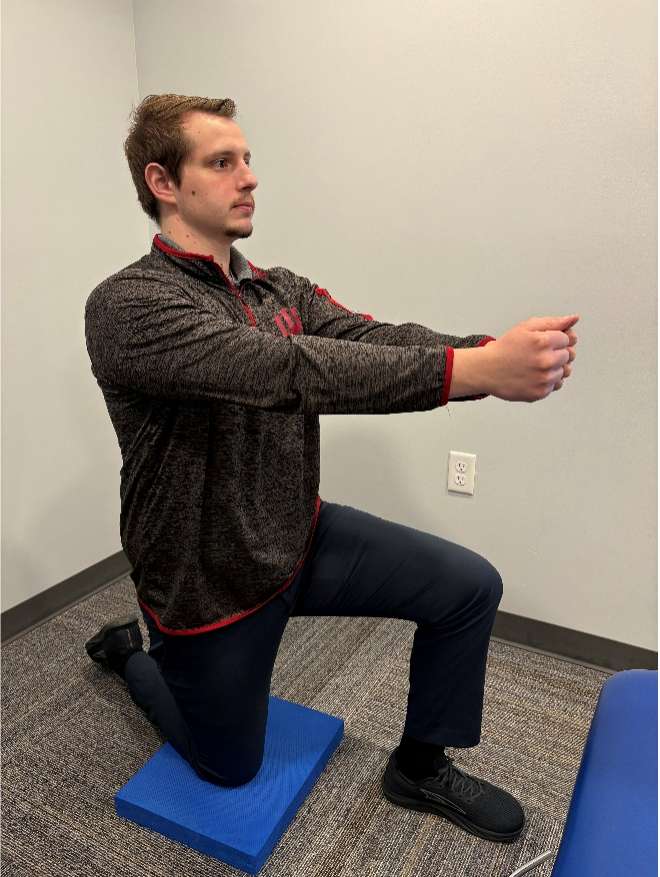
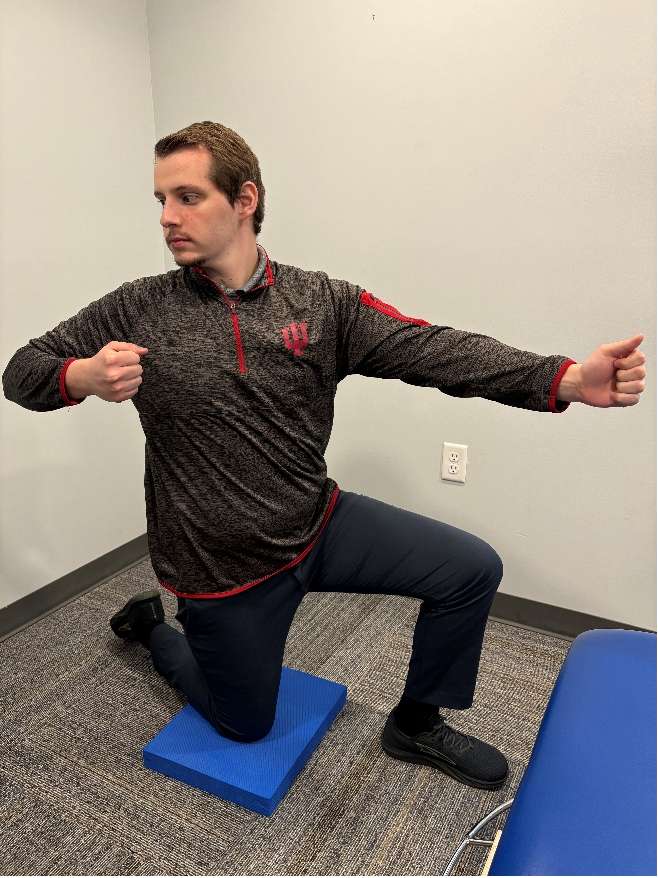
Half Kneeling Archer
Like we discussed earlier if your mid back is not moving properly or it is “weak” then it can cause issues with rotation while you swing leading to your low back having to rotate more to make up for this, thus leading to pain. This exercise will help to address any potential rotational deficits in the mid spine. It can also be used as a strengthening exercise as well once you feel comfortable with doing the exercise without a band. The exercise goes as follows:
- Staring in a half-kneeling position (one knee down, one foot forward).
- Gently tuck your pelvis in line with your rib cage (this is called a posterior pelvic tilt) to stabilize your low back.
- Then bring your arms straight out in front of your body.
- Pull one of your arms straight back like you are pulling the string of a bow and turn your head back while doing this, allowing your shoulders to turn as well.
- You should feel a stretch in your mid back.
- If this motion becomes easy and/or you feel comfortable with the correct form, you can add in a light resistance band to increase the load on the muscles creating strength gains.
- Do this in a pain free motion and do 2 sets of 10-12 reps of these on each side.
Half-Kneeling Hip Flexor Stretch
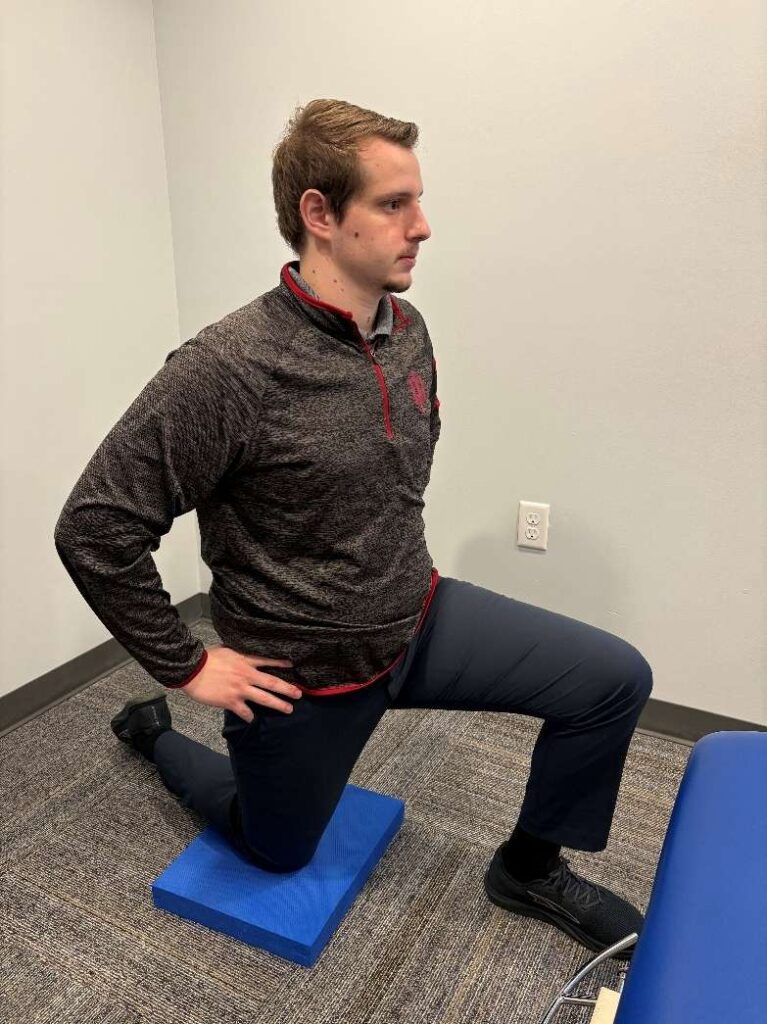
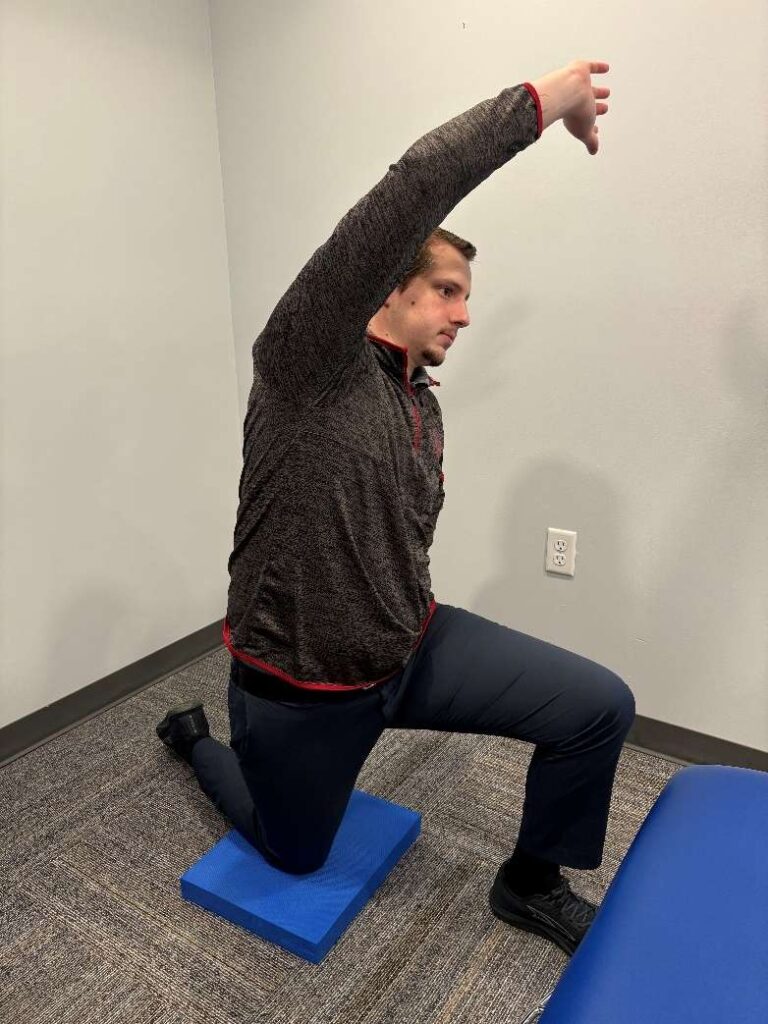
We also discussed how a lack of mobility near the hip can cause issues with the low back during your golf swing. Your main hip flexor group the iliopsoas complex start in the low back and crest of your hip and cross your hip to attach onto your femur. If these muscles become too tight, potentially from sitting at work for extended periods of time, it can limit the ability of your hip to extend as you finish your swing. This will cause your lower back to have to extend more than it should because the hip is not moving properly, thus potentially causing pain. This exercise will help address those tight hip flexors if that is your problem. The exercise goes as follows:
- Starting in a half-kneeling position (one knee down, one foot forward)
- Tuck your pelvis under your rib cage (posterior pelvic tilt).
- Shift your weight forward onto your front foot until you feel a stretch in the front of your hip.
- Once you are comfortable with this position side bend your trunk towards the front leg.
- Hold for 30 seconds do 2-3 reps of these on each side.
- Do this in your pain free motion.
Bird Dog
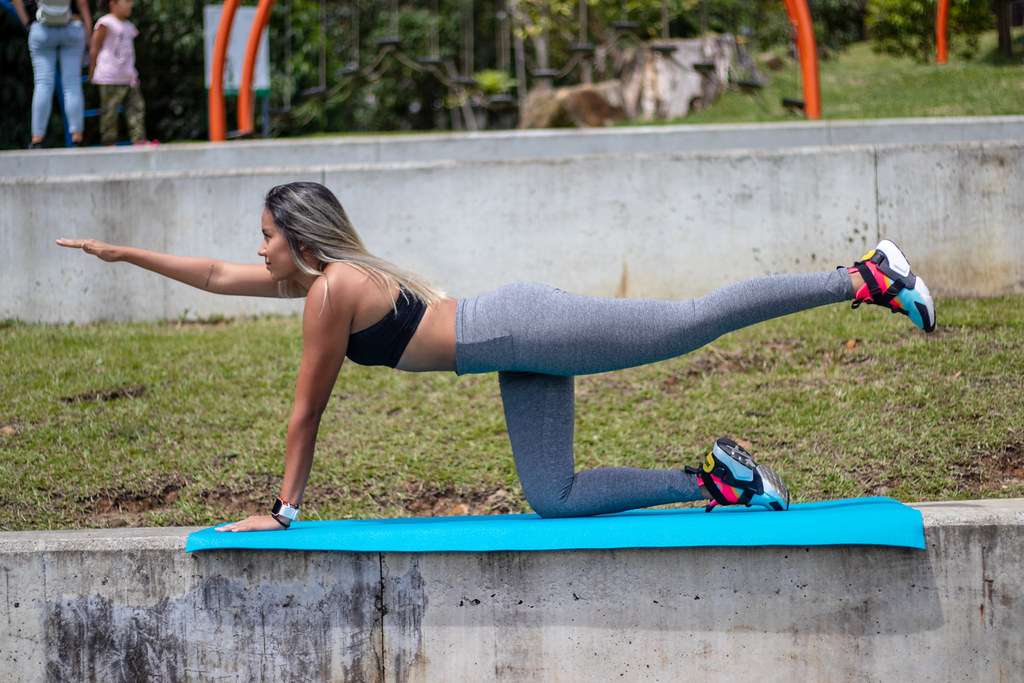
Lastly, we have the bird dog exercise. This is a classic exercise for low back pain that works on core stabilization with arm/leg movement. Core stabilization is important in all aspects of movement but especially as we walk and swing a golf club. If your abdominal muscles or “core” is not working properly due to weakness, then your low back musculature will end up working overtime potentially causing pain. This exercise is a good beginner level exercise to get into abdominal training. The exercise goes as follows:
- Get into a quadruped position (on your hands and knees).
- Line up your back so that it is at the same level as your head and neck. This creates a nice neutral spine.
- Bring one arm up and the opposite diagonal leg back to the level of your back and then return to the ground.
- Do not let your pelvis tip left to right or your back to lose its neutral position while doing this exercise. This is where you must focus on engaging your abdominal muscles to keep yourself from tipping.
- Alternate your hands and legs as shown, this should be a pain free movement.
- Do 2 sets of 10-15 reps.
In conclusion, while these exercises may help, if you are in consistent low back pain while golfing, or low back pain in general, ProTailored Physical Therapy can help! We will find the root cause of the pain and begin the rehab process specifically tailored to your individual needs. Call us at 260-739-0300 to schedule your consultation and take the first step towards your pain free life.