
3 Exercises for Upper-Back/Shoulder Pain During Golfing
Do you get pain or a stiff feeling near the middle of your back upon swinging a golf club? Maybe your pain is closer to your shoulder? Or are you wanting to find exercises to get your body primed and ready for the golf swing as the season begins? If your answer is yes to any of these questions this is the article for you! In this article we will go over common causes of this pain and give 3 exercises that may help relieve this and get you back to feeling your best on the course.
There are many causes of pain during a golf swing as the swing is a complex body movement. However, in this article we will discuss how the thoracic spine specifically can be a key factor in eliminating your upper body pain while swinging the club. If you are unfamiliar with the term thoracic spine, it is the portion of your spine extending from the bottom of your neck to the start of your low back, your “mid back”. You have 12 thoracic vertebrae that all must work together in allowing you to rotate your mid-spine/shoulders and extend your spine slightly while swinging the club. The pain that you feel in this region could be from the thoracic spine not moving correctly or you may lack the ability to control your spine properly. This can cause pain in the thoracic spine itself, but a lack of mobility/control of your spine can also lead to pain in other areas that are compensating for lack of mobility in the spine, such as shoulder pain.
If you are having pain in the mid-back, you can try to relieve the pain with heat prior to playing golf to get your muscles warmed up. In addition, you can attempt to roll out a “muscle knot” in your mid-back by using a lacrosse ball or a tennis ball.
How can ProTailored help you with this pain? Here at ProTailored we specialize in proving high-level, 1-on-1 care with each individual patient. This means we can tailor exercise programs to what your specific individual body needs to help you get out of pain. Some examples of what your exercise program could include are: BFR training (blood flow restriction), neuro-muscular control training, weight training, and body mechanic optimization. Our therapists are also trained in various manual techniques such as IASTM and cupping to assist with muscle tension and healing. In addition, our therapists are well versed in various joint mobilizations to assist with joint restriction and increase mobility. We also provide dry-needling services to assist with your healing process back to doing the things you love pain free.
What can you do at home in the meantime to assist with getting rid of your pain? These next three exercises will focus on thoracic spine mobility and control as discussed earlier. The focus with these exercises is to allow for your spine to rotate and extend properly, leading to a smoother feeling swing and better upper body mechanics as you swing, thus reducing pain. Even if you do not have pain while swinging currently, these exercises are great to perform daily to keep yourself from getting injured.
Side-lying Open Book
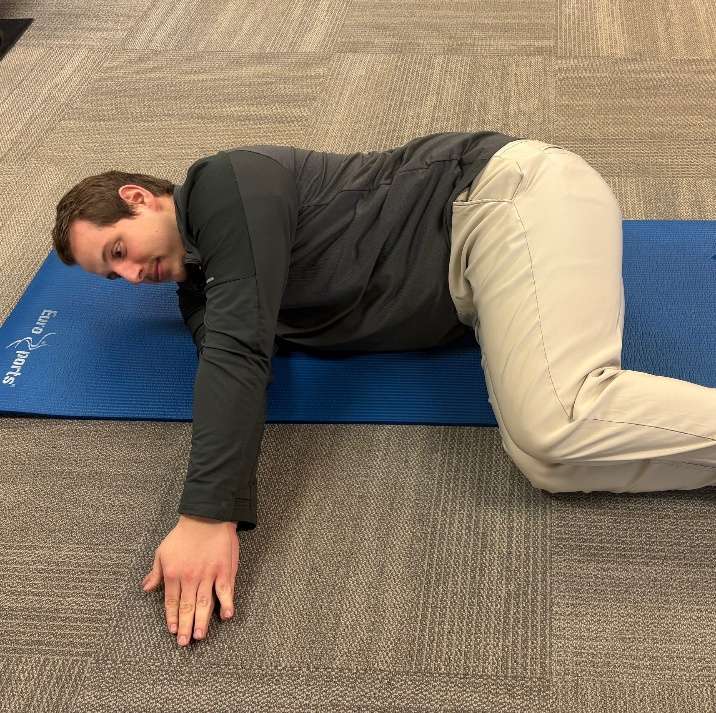
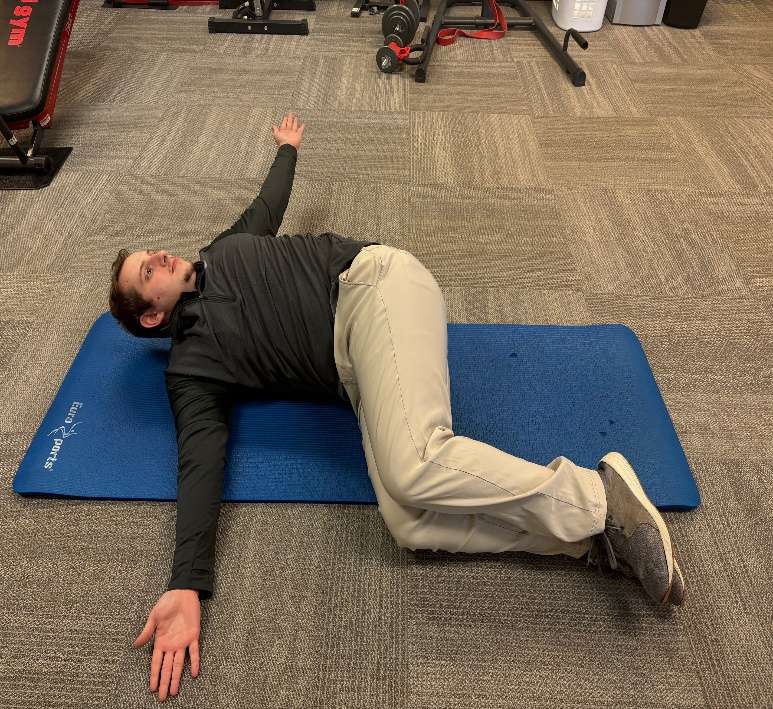
The side-lying open book is a great way to target thoracic spine mobility by increasing thoracic spine rotation. It is also an exercise that can be completed at home without any equipment, all you need is something to lay on. The steps for the exercise are as follows:
- Lay on either your right or left side.
- Bring your knees up to your hips so they make a 90 degree angle.
- Next rotate the arm that is on the top with a straight arm towards the oppose side of your body, as shown in the picture.
- This is to be completed in a pain-free range of motion.
- You can place a pillow under your neck if neck is uncomfortable.
Foam Roller Thoracic Extension
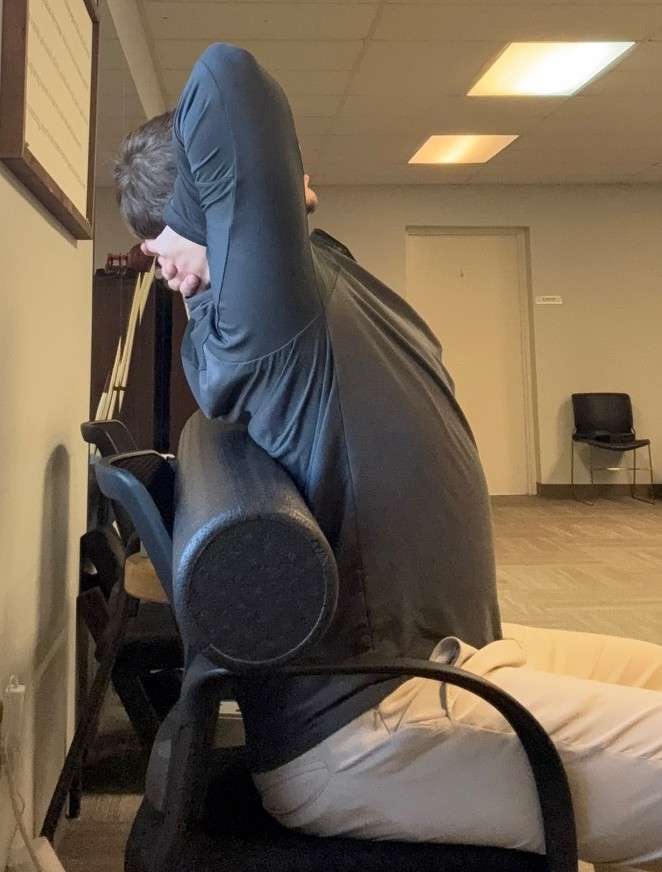
This exercise focuses on the thoracic extension component of the golf swing. As you are following through in the swing, your thoracic spine must extend to help your body complete the swing. This exercise will address a potential lack of thoracic extension mobility. The steps are as follows:
- Place a foam roller across the back of a chair in line with the middle of your back or with you laying onto your back.
- Clasp your hands around your neck.
- Bring your elbows up towards the ceiling using your mid-back muscles. You are not looking up with your neck; you are using your mid back muscles to extend your back over the foam roller.
- Do this in a pain free range of motion.
Half-Kneeling Rotational Lift
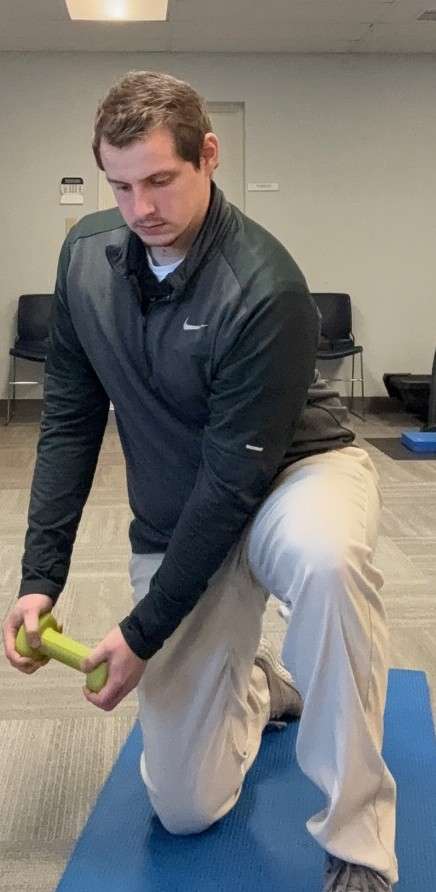
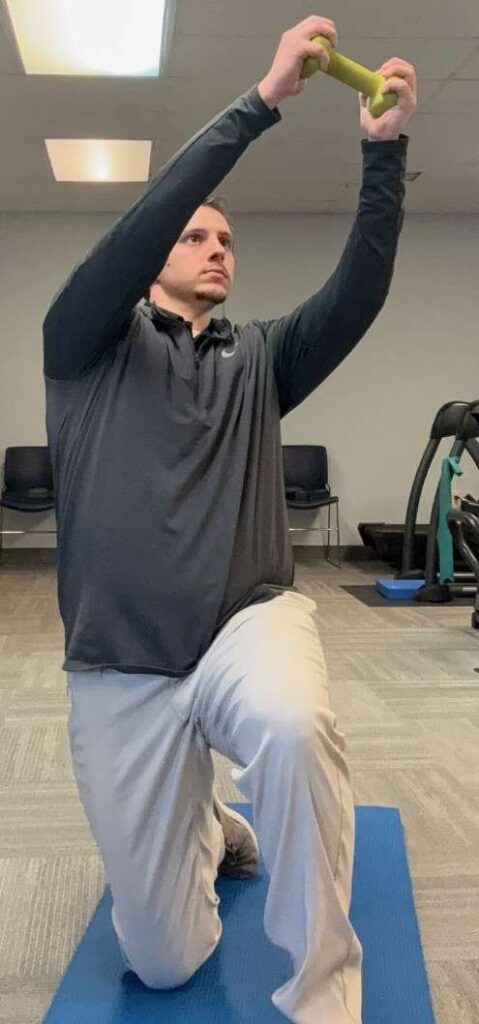
This exercise is to help address the muscular control portion of the thoracic spine during the swing that we discussed earlier. The half kneeling rotation is a strength building exercise for your core and the muscles in your back. Going slow with proper form is essential in this exercise to avoid injury. Also, begin with light weight or no weight until you feel comfortable with the form for this exercise. The instructions are as follows:
- Start by getting onto one knee with the opposite foot in front of the other knee
- While keeping your back up tall, hips stable, reach down towards the knee that is on the ground and then bring your arms over your head to opposite shoulder.
- This is a “low to high” motion.
- You should do this in a pain-free range of motion, if this is too easy without weight you can add a therapy band or a weight such as a dumbbell/medicine ball. However, start with light weight and work your way up to heavier weights.
In conclusion, while these exercises may help, if you are in consistent mid-back/shoulder pain while swinging a golf club, ProTailored Physical Therapy can help! We will find the root cause of the pain and begin the rehab process specifically tailored to your individual needs. Call us at 260-739-0300 to schedule your consultation and take the first step towards your pain free swing.