
Favorite Body Weight Exercises to Strengthen Abdominal Muscles and Improve Core Stability
(Part 2!)

Why is it important to strengthen the abdominal muscles?
Your body has a natural corset muscle called the transverse abdominis. This muscle
attaches at the spine and attaches to a line of tissue in the front of your stomach. This
muscle helps to support and stabilize your spine when you are walking and performing
daily tasks. Strengthening the transverse abdominis and the other abdominal muscles
helps to reduce the risk of straining your back or causing other injury to your spine. Your
abdominal muscles should be engaged when you are lifting, performing pushing and
pulling motions, performing repetitive bending tasks, or activities in which your arms and
legs move but your trunk remains stable (running, seining a golf club or tennis racquet,
dancing, etc.). If you are not activating your abdominal muscles or if you are holding
your breath (referred to as a Valsalva), you may suffer an injury to the soft tissue or bony
structures in your spine and back.
What is the best way to strengthen the abdominal muscles?
Many people think of doing a lot of sit ups to strengthen their abdominal muscles;
however, sit ups have been shown to place excessive stress on the spine and promote
abnormal curvature of the spine. In this article, we will go over some of my favorite
abdominal exercises that can help to progressively strengthen your abdominals and
reduce your risk for injury.
Supine Toe taps
Lay on your back with a carpet or yoga mat underneath you. If you are still working on
building up your abdominal strength or are new to doing this exercise, make a triangle
with your hands and place this under your tailbone. This will help you keep your spine
from compensating during the exercise and cue you to keep your abdominal muscles
engaged. Position your legs so that your hips and knees are each at 90 degree angles.
Keeping your abdominal muscles engaged and breathing, lower one foot toward the
ground as if dipping your big toe into water. Return your leg to the starting position and
repeat with the opposite leg. Continue to alternate legs, performing 10 toe taps on each
side. Repeat for 3 sets.

Double Leg Drop
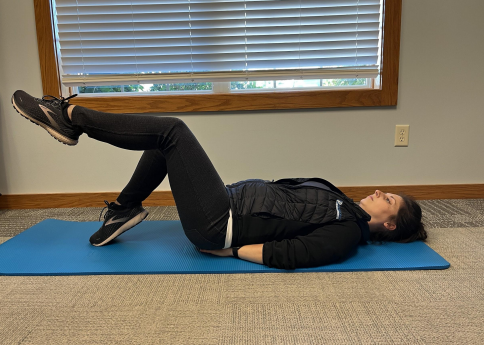
Start by laying on your back with a yoga mat or carpet under you. If you are still working
on building up your abdominal strength or are new to doing this exercise, make a triangle
with your hands and place this under your tailbone. This will help you keep your spine
from compensating during the exercise and cue you to keep your abdominal muscles
engaged. Position your legs so that your hips are at 90 degrees and your knees are as
straight as your hamstring flexibility will allow. Tighten your abdominal muscles and
ensure that you are breathing with this activation. On the inhale, lower your legs toward
the floor then raise them back up to the starting position. If you start to lose your
abdominal muscle engagement or your lower back starts to arch, do not lower your legs
as far. Perform 10 repetitions 3 times. As you get stronger, try to lower your legs closer to
the ground.


Down Dog to Up Dog
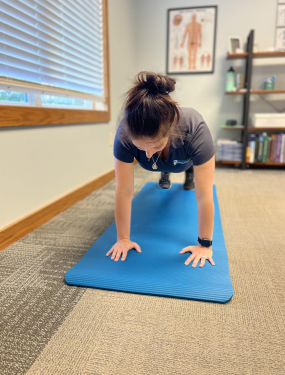
Begin in the full plank position discussed earlier in this article. For the down dog, push
your hips back toward your feet and up toward the ceiling. Your arms and legs should
remain fairly straight and you should keep your abdominal muscles engaged throughout.
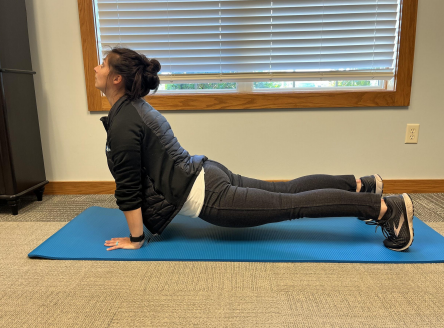
Next, you will return to the plank position. Then, lower your hips toward the floor and
allow your back to very slightly arch back. Keep your hips hovering above the floor. Be
sure that your shoulders are down and not raised into your ears. Then return to the plank
position and continue to alternate from down dog, through plank into the up dog position.
Perform 10 of each, rest, then repeat for 3 sets.

These exercises are not for everyone and should not be performed if you have recently had
surgery or have experienced a recent injury. If you are currently experiencing back pain, hip
pain, neck pain, call 260-900-2437 to schedule an appointment with a ProTailored Physical
Therapist today!