
Introduction To The Foot
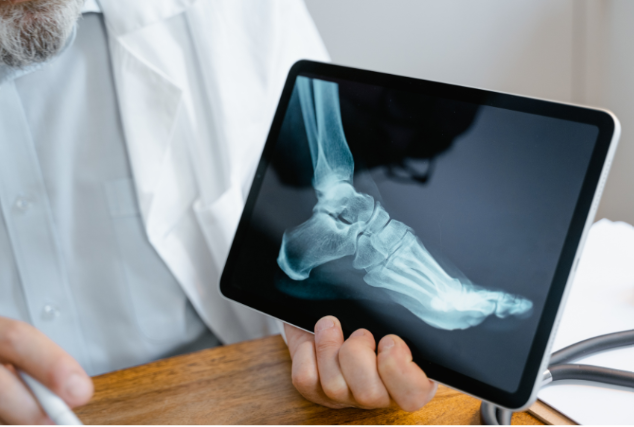

- Did you know?
- The foot is made up of 28 bones and 30 joints, and more than 100 muscles, tendons and ligaments
- Together these structures work to carry out weight bearing and propulsion (forward movement)
- The foot must also be flexible to adapt to uneven surfaces and remain stable.
- The foot has 3 sections: forefoot, midfoot, hindfoot
- Forefoot:
- Phalanges – aka toes! They are made up of a total of 14 bones: 2 for the big toe and 3 for the other four toes.
- Metatarsals – these are 5 long bones that extend from the base of each toe to the midfoot. The first metatarsal bone leads to the big toe and plays an important role in propulsion (forward movement). The second, third and fourth metatarsal bones provide stability to the forefoot.
- Sesamoid bones – these are two small, oval-shaped bones beneath the first metatarsal on the underside (plantar surface) of the foot. It is embedded in a tendon at the head of the bone (the nearest to the big toe). Its role is to reinforce and reduce stress on the tendon.
- Midfoot:
- The midfoot contains 5 irregularly shaped bones called the tarsals. Together the tarsals form the arch of the foot. The arch plays a key role in weight bearing and foot stability.
- These bones include:
- Navicular
- Cuboid
- Medial cuneiform
- Intermediate cuneiform
- Lateral cuneiform
- Hindfoot:
- Calcaneus: this is the large bone at the heel of the foot. Its main function is to transfer most of the body weight from the legs to the ground.
- Talus: This is the bone that sits between the calcaneus and the two bones of the lower leg (tibia and fibula). It helps transfer weight and pressure across the ankle joint.
- Muscles
- The main muscles that facilitate movement in the foot:
- Tibialis posterior: supports the foot’s arch
- Tibialis anterior: allows the foot to move upward
- Peroneus longus and brevis: control movement on the outside of the ankle
- Extensors: raise the toes and make it possible to take a step
- Flexors: stabilize the toes and curl them under
- The main muscles that facilitate movement in the foot:
- Tendons – fibrous connective tissue that connects muscles to bones or surrounding structures.
- Ligaments – fibrous connective tissue that connects bones to bones and helps to hold the structures together
For more information, reach out to ProTailored Physical Therapy or call us at (260)739-0300 to get scheduled at one of Fort Wayne Physical Therapy clinics.